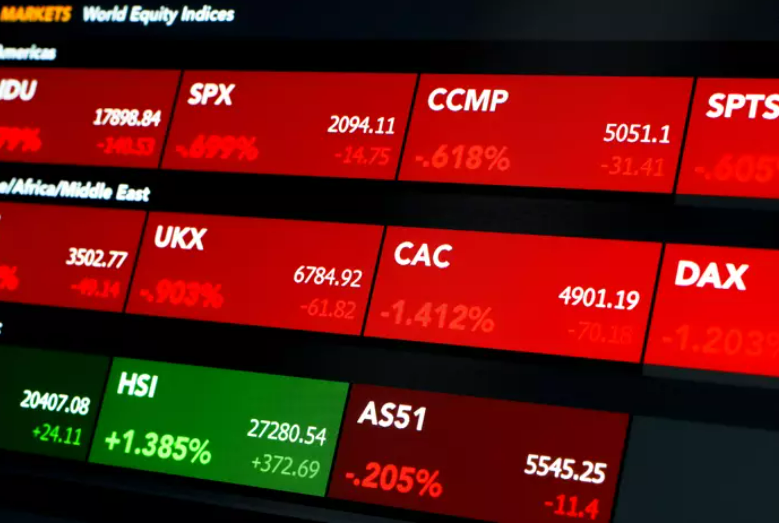
Global markets opened on Sunday, June 12th, before the Fed announcement, and immediately began selling lower. On Monday, June 13, US indexes fell by more than 2.5 percent practically everywhere. In early trade on Thursday, June 16, a modest rise after the Fed announcement seemed to have faded.
Global markets clearly anticipated inflation to remain high, but they were expecting for some modestly lower data to prove that the Fed's recent actions had already alleviated some inflation fears.
Now that the US Fed looks to be up against a brick wall, it has hiked rates aggressively upwards in an attempt to keep inflation at bay (and possibly destroy global asset values). For the US Fed and global central banks, this is uncharted ground, in my opinion. As a result, traders can anticipate more volatility and the probability of a strong price reversal over time.
Do you know where the market is going? Take advantage of this opportunity right now.
74% of retail CFD accounts are losing money.
Another global financial crisis might be on the horizon.
My team and I did research that uncovered some intriguing new information. The US Current Account data, in particular, is extremely close to the levels seen immediately before the Global Financial Crisis (GFC) in 2006 (around -$218 billion). Since the COVID-19 viral outbreak, the US economy, inflation, consumer involvement, and asset prices have all proceeded to hyperinflate, in my opinion.
Over the last ten years or more, the global markets have continued to absorb inexpensive US Dollar liabilities as the US Federal Reserve has maintained interest rates exceptionally low for a lengthy period of time. As rates rose, this not only fueled an excessive global speculative phase, but it also produced an acute credit/debt liability concern throughout the world. Over-leveraged debtors are obliged to carry debt forward at higher rates if they are unable to pay off their debts in full. The beginning of the Global Financial Crisis was remarkably similar to this situation. Speculative trading in Mortgage-Backed Securities and other global assets with excessive leverage.
This Issue Was Spotted By Skilled Traders I've been warning my followers for years that an event like this was about to begin in 2020 and 2021. I've included an example from our blog below, which warned traders that the world markets were migrating away from the perpetual positive price patterns that had been in place from 2011 to 2021.
PART I OF HOW TO SPOT THE END OF AN EXCESS PHASE – November 25, 2020
Before attempting to find any support, the NASDAQ may fall below $9,750.
The Technology Sector is leading the US main indices' negative price trend. Before trying to find any serious support, the NASDAQ might fall to levels of $9,750-10,750.
The NASDAQ may eventually collapse to values approaching the COVID-19 lows, about $6,500. However, the most plausible support level is now located slightly above the COVID-19 2020 highs.
This new worldwide price revaluation, in my opinion, will endure through the remainder of 2022 and probably into early 2023. It all hinges on what the US Federal Reserve does and how this scenario plays out. We may witness a protracted downturn as global expectations convert to new normal economic expectations if there is an orderly unwinding of excesses in the markets. If a major crisis event, such as the one that blew a large hole in the global economy in 2008-09, occurs, global markets may see a sharp drop.
According to my study, the US Federal Reserve is far behind the curve and has allowed the excessive speculative surge to continue for far too long. Near the close of 2020 and the beginning of 2021, global central banks should have begun hiking rates to reasonable levels. With the DOT COM and GFC events merging, we now have an extra phase bubble. We are in the midst of a worldwide credit/liability bubble, as well as an extreme technology bubble.
It's time to adjust your assets to protect against downside risks if you haven't already. Please consider the long-term risks of attempting to ride out any extended price downtrend. Are you ready to risk another 5% to 10% of your assets in the hopes that the global markets will soon bottom out?
What are some strategies that might assist you in navigating current market trends?
Learn how we utilize particular technologies to better analyze pricing cycles, set-ups, and price target levels in a variety of industries. Also, find out how we discover strategic trade entrance and exit sites.
We foresee quite big price fluctuations in the US stock market during the next 12 to 24 months. As global traders strive to identify the next significant trends, the markets have begun to shift away from the continuing central bank support rally phase and have entered a revaluation period. As traders and investors seek safe havens in Metals and other safe havens, precious metals will likely begin to operate as a good hedge.




 Real-time News