• English
  • 简体中文
  • 繁體中文
  • Tiếng Việt
  • ไทย
  • Indonesia
Subscribe
Real-time News
The U.S. FHFA house price index rose 0.1% month-on-month in January, with the previous reading revised from 0.10% to 0.3%.The U.S. FHFA house price index rose 1.6% year-on-year in January, revised from 1.8% to 1.9% in the previous month.March 31 - According to foreign media reports, drone attacks on key Russian ports have caused Russian oil shipments to plummet to their lowest level in over a year. Shipments from the Baltic region have fallen to their lowest level since Moscow launched its military operation against Ukraine in 2022. Multiple attacks on the Primorsk and Ust-Luga oil export terminals caused port traffic to drop to about one-third of the previous week. Russian weekly crude oil exports plunged by 1.75 million barrels per day to 2.32 million barrels per day last week, but the impact on the four-week average shipments was relatively mild. In the 28 days ending March 29, average shipments decreased by 280,000 barrels per day to 3.31 million barrels per day, the lowest in two months. While crude oil shipments declined, the volume of Russian crude oil shipments previously stranded at sea increased significantly. Crude oil receptions to India jumped to nearly 1.7 million barrels per day this month, up from about 1.1 million barrels per day in February, after the United States issued waivers allowing the purchase of Russian crude oil loaded before March 12.On March 31, Shenzhen released its 2025 Housing Provident Fund Annual Report. In 2025, Shenzhen issued 48.903 billion yuan in personal housing provident fund loans, a year-on-year increase of 27.90%, supporting 41,400 employee families in purchasing 3.6756 million square meters of housing.U.S. Redbook retail sales annual rate for the week ending March 27 was 6.9%, compared to 6.7% previously.

US Inflation Cools to 8.3% but Eases Less than Forecast, Nasdaq 100 Sinks as Yields Rise

Cory Russell

May 12, 2022 10:40

微信截图_20220419102342.png


Inflation in the United States decreased in annual terms last month, but remained at multi-decade highs and more than four times the Federal Reserve's 2 percent goal, according to Labor Department statistics published on Wednesday.


According to the latest report from the agency, the consumer price index increased 0.3 percent in April after rising 1.2 percent in March, bringing the 12-month reading to 8.3 percent from 8.5 percent, indicating that inflationary pressures reached their peak at the end of the first quarter but are still struggling to cool materially. CPI was expected to grow 0.2 percent month over month and 8.1 percent year over year, according to analysts polled by Bloomberg News.


When looking at the monthly drivers of the headline statistic, food costs increased by 0.9 percent, keeping pace with previous rises in this category. Meanwhile, energy expenses declined by 2.7 percent after rising by 11% in March due to rising oil prices after Russia's invasion of Ukraine. This is a good sign since it means the worst of the commodities market shock may have passed.


Excluding food and energy, the core CPI rose 0.6 percent on a seasonally adjusted basis and 6.2 percent year over year, reducing transient noise and reflecting longer-term economic trends. The decrease in the annual number, which fell from 6.5 percent, tends to support the hypothesis that the core gauge peaked in March as well.


The shelter index gained 0.5 percent in monthly contributions for the core indicator, mirroring the previous two months' growth, despite a tight rental market. Meanwhile, transportation increased by 3.1 percent, indicating a shift in household demand toward service spending. Used automobiles and trucks, on the other hand, continued to tumble, down 0.4 percent after losing 3.8 percent in March due to cooling demand and lowering durable-goods prices.


With inflation decreasing but not falling much, it's unclear if we've hit the apex of central bank policy hawkishness. In this environment, yields may continue to rise on anticipation of a more aggressive tightening reaction. This scenario might heighten worries that the Fed's rate hikes would lead to a recession, depressing confidence and hindering the stock market's rebound.


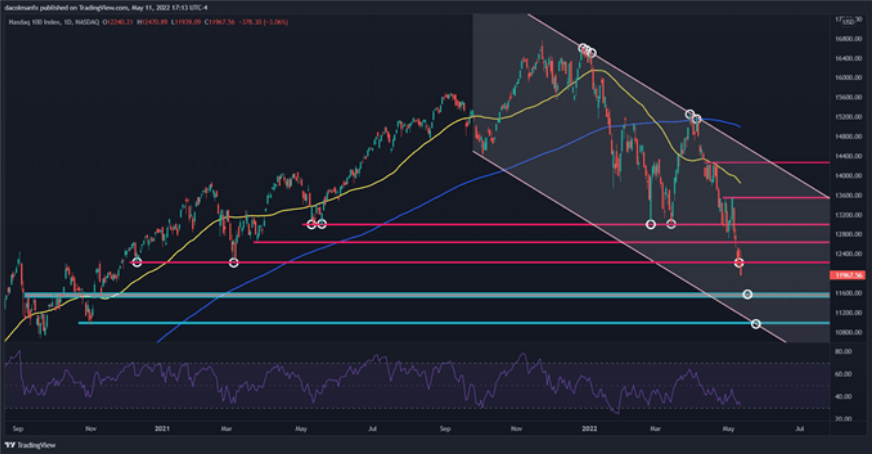
U.S. Treasury rates surged immediately after the CPI statistics were released, causing the Nasdaq 100 futures to lose all of their pre-market gains and fall more than 1% into negative territory. Officials from the Federal Reserve have said that they support interest rate rises in half-percentage-point increments, but have shown little taste for greater changes. At the face of persistent inflation, the bank may opt for large 75-basis-point rises in upcoming sessions in order to get monetary policy closer to neutral sooner. Stocks are at danger as a result of this.