• English
  • 简体中文
  • 繁體中文
  • Tiếng Việt
  • ไทย
  • Indonesia
Subscribe
Real-time News
On January 12th, Google announced on the 11th that it will partner with major retailers such as Walmart to expand the shopping functionality of its Gemini AI model, upgrading the Gemini app from a "smart assistant" to a "virtual merchant" capable of directly completing transactions. The Gemini app will introduce an "instant checkout" feature, allowing consumers to purchase goods from select merchants within the chat interface, without needing to open any external interface. Walmarts incoming president and CEO, John Furner, stated that the shift from traditional web or app search to "agent-driven commerce" represents the next major evolution in the retail industry. Industry insiders believe that the application of AI in e-commerce and its impact on consumer behavior will be a key focus of the conference. Google stated that the shopping functionality of the Gemini AI model will initially be available only to US users, but will expand to international markets in the coming months.On January 12, Clover Biotech (02197.HK) announced that its Pre-F trimeric subunit recombinant protein respiratory combination vaccine candidates SCB-1022 (RSV+hMPV) and SCB-1033 (RSV+hMPV+PIV3), developed based on the companys self-developed Trimer-Tag vaccine R&D platform, have completed the first batch of subject enrollment in Australia and officially started Phase 2 clinical trials.On January 12th, Citigroup pointed out that Indonesias fiscal deficit this year may far exceed the statutory limit, as the government increases spending on the nationwide free meal program and reconstruction projects in flood-stricken provinces of Sumatra. In a report on Monday, Citigroup economist Helmi Arman revised his 2026 budget deficit as a percentage of GDP upward to 3.5% from the initial 2.7%. Citigroups base case assumption is that the government will amend the National Fiscal Law by the second half of this year to relax the long-standing 3% fiscal deficit cap. Arman stated that if the authorities choose to significantly cut spending to maintain fiscal discipline, they may avoid exceeding the limit. He predicts that by 2029, Indonesias debt-to-GDP ratio will rise from approximately 39% in 2025 to 42%.January 12th - In 2025, the judicial auction market showed a year-on-year decline in the number of listings, transactions, transaction value, and average price. A total of 719,000 units were listed for auction (down 6.6% year-on-year), with 169,000 units sold (down 4.4% year-on-year), for a total transaction value of 253.62 billion yuan (down 23.6% year-on-year), and an average discount rate of 74.1%. Residential properties were the core property type (accounting for 51.9% of transaction value), with second-round auctions accounting for the highest proportion of transactions (46.9%). Regionally, high-priced properties were concentrated in first-tier and core second-tier cities, with Shenzhen, Shanghai, and Beijing forming the first tier. Meanwhile, regional differentiation intensified, with significant differences in performance among key cities. The transaction structure optimized, with second-round auctions becoming the core transaction channel, and bidders preferring to make purchases at more attractive prices. The judicial auction market exhibited an independent cyclical trend, with monthly transaction volume and value significantly affected by the courts enforcement pace, showing marked fluctuations.On January 12th, JPMorgan Chase raised its target price for UBTECH Robotics Corp. (09880.HK) from HK$154 to HK$169, primarily reflecting an increase in the expected price-to-revenue ratio for fiscal year 2027 from 12x to 13x, in line with the latest industry average; it maintained its "Overweight" rating. The bank noted that UBTECHs share price surged 130% in 2025, making it one of the best-performing stocks in the Asian automation and robotics sector. While the companys performance has been stable year-to-date and broadly in line with major indices, the bank remains positive on its prospects. The bank believes that although the industry and UBTECH are still in their early stages with limited commercialization, these risks are gradually mitigating due to substantial progress in commercialization, increased customer adoption, and strong policy support from the US-China competition for leadership in humanoid robots.

Will Global Markets Be Pushed Deeper Into Crisis Event By The US Fed

Skylar Shaw

Jun 17, 2022 15:35

微信截图_20220617152400.png


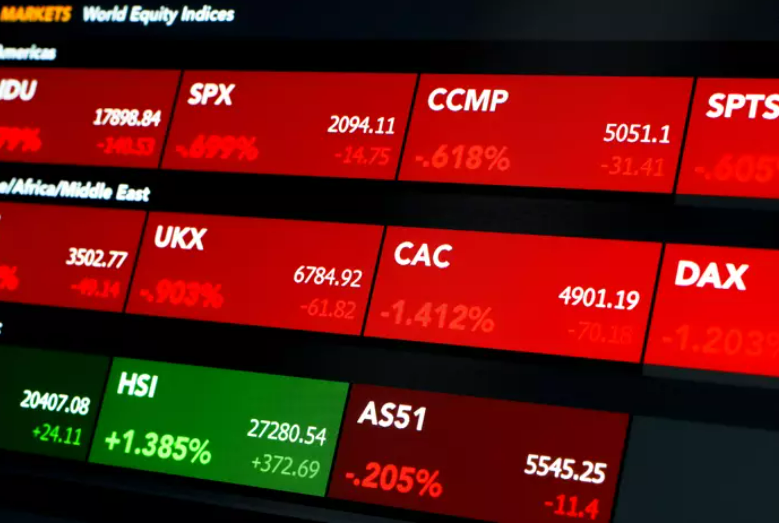
Global markets opened on Sunday, June 12th, before the Fed announcement, and immediately began selling lower. On Monday, June 13, US indexes fell by more than 2.5 percent practically everywhere. In early trade on Thursday, June 16, a modest rise after the Fed announcement seemed to have faded.


Global markets clearly anticipated inflation to remain high, but they were expecting for some modestly lower data to prove that the Fed's recent actions had already alleviated some inflation fears.


Now that the US Fed looks to be up against a brick wall, it has hiked rates aggressively upwards in an attempt to keep inflation at bay (and possibly destroy global asset values). For the US Fed and global central banks, this is uncharted ground, in my opinion. As a result, traders can anticipate more volatility and the probability of a strong price reversal over time.


Do you know where the market is going? Take advantage of this opportunity right now.


74% of retail CFD accounts are losing money.


Another global financial crisis might be on the horizon.


My team and I did research that uncovered some intriguing new information. The US Current Account data, in particular, is extremely close to the levels seen immediately before the Global Financial Crisis (GFC) in 2006 (around -$218 billion). Since the COVID-19 viral outbreak, the US economy, inflation, consumer involvement, and asset prices have all proceeded to hyperinflate, in my opinion.


Over the last ten years or more, the global markets have continued to absorb inexpensive US Dollar liabilities as the US Federal Reserve has maintained interest rates exceptionally low for a lengthy period of time. As rates rose, this not only fueled an excessive global speculative phase, but it also produced an acute credit/debt liability concern throughout the world. Over-leveraged debtors are obliged to carry debt forward at higher rates if they are unable to pay off their debts in full. The beginning of the Global Financial Crisis was remarkably similar to this situation. Speculative trading in Mortgage-Backed Securities and other global assets with excessive leverage.


This Issue Was Spotted By Skilled Traders I've been warning my followers for years that an event like this was about to begin in 2020 and 2021. I've included an example from our blog below, which warned traders that the world markets were migrating away from the perpetual positive price patterns that had been in place from 2011 to 2021.

PART I OF HOW TO SPOT THE END OF AN EXCESS PHASE – November 25, 2020

Before attempting to find any support, the NASDAQ may fall below $9,750.


The Technology Sector is leading the US main indices' negative price trend. Before trying to find any serious support, the NASDAQ might fall to levels of $9,750-10,750.


The NASDAQ may eventually collapse to values approaching the COVID-19 lows, about $6,500. However, the most plausible support level is now located slightly above the COVID-19 2020 highs.


This new worldwide price revaluation, in my opinion, will endure through the remainder of 2022 and probably into early 2023. It all hinges on what the US Federal Reserve does and how this scenario plays out. We may witness a protracted downturn as global expectations convert to new normal economic expectations if there is an orderly unwinding of excesses in the markets. If a major crisis event, such as the one that blew a large hole in the global economy in 2008-09, occurs, global markets may see a sharp drop.


According to my study, the US Federal Reserve is far behind the curve and has allowed the excessive speculative surge to continue for far too long. Near the close of 2020 and the beginning of 2021, global central banks should have begun hiking rates to reasonable levels. With the DOT COM and GFC events merging, we now have an extra phase bubble. We are in the midst of a worldwide credit/liability bubble, as well as an extreme technology bubble.


It's time to adjust your assets to protect against downside risks if you haven't already. Please consider the long-term risks of attempting to ride out any extended price downtrend. Are you ready to risk another 5% to 10% of your assets in the hopes that the global markets will soon bottom out?


What are some strategies that might assist you in navigating current market trends?


Learn how we utilize particular technologies to better analyze pricing cycles, set-ups, and price target levels in a variety of industries. Also, find out how we discover strategic trade entrance and exit sites.


 We foresee quite big price fluctuations in the US stock market during the next 12 to 24 months. As global traders strive to identify the next significant trends, the markets have begun to shift away from the continuing central bank support rally phase and have entered a revaluation period. As traders and investors seek safe havens in Metals and other safe havens, precious metals will likely begin to operate as a good hedge.