• English
  • 简体中文
  • 繁體中文
  • Tiếng Việt
  • ไทย
  • Indonesia
Subscribe
Real-time News
According to Futures News on April 27, crude oil prices remain supported, but end-user demand is insufficient, coupled with weak refined oil prices. The PX market is expected to rise today, but the increase will be limited.On April 27th, according to foreign media reports, multiple positive factors supported a firm global corn market price trend. 1. Demand: US corn export sales for the 2025/26 marketing year reached 74.1 million tons, a year-on-year increase of 28%, reaching 88% of the USDAs annual target, higher than the historical average of 84%. 2. Supply: Brazils second-season corn production is estimated at 109.12 million tons, a year-on-year decrease of 3.6%. Weather forecasts indicate that drought will continue in Brazils central-western and southeastern regions for the next two weeks, potentially affecting the growth of second-season corn during the pollination period. 3. Planting progress: As of April 19th, US corn planting was 11% complete, higher than the five-year average of 9%. The market expects planting progress to reach 20% to 22% by the week ending April 26th, but rainy weather in the eastern corn belt is drawing market attention. 4. Energy and External Impacts: Due to the continued closure of the Strait of Hormuz, Brent crude oil futures were at $105.33 per barrel, up 16.54% week-on-week. Soaring energy prices and escalating tensions in the Middle East exacerbated volatility in the corn market. 5. Production Forecast: The International Grains Council (IGC) lowered its 2026/27 global corn production forecast by 2.9 million tons to 1.2999 billion tons, and its global ending stocks forecast by 2.4 million tons to 291.5 million tons.Futures News, April 27th - According to foreign media reports, Malaysian crude palm oil futures on the Bursa Malaysia Derivatives Exchange (BMD) are likely to open higher on Monday morning, following gains in external markets. Escalating tensions in the Middle East have fueled a strong rebound in international crude oil futures, coupled with strength in Chicago soybean oil futures, which will likely support the early performance of Malaysian crude palm oil futures. Plans by Malaysia and Indonesia to increase the blending ratio of palm oil-based biodiesel will boost domestic palm oil demand in both countries, potentially leading to tighter export supplies and supporting prices. However, weak palm oil exports so far in April will limit the upside potential of the palm oil market.1. International precious metals futures generally closed higher. COMEX gold futures rose 0.03% to $4725.40 per ounce, down 3.16% for the week; COMEX silver futures rose 0.24% to $75.69 per ounce, down 7.52% for the week. The conclusion of the US Department of Justices investigation into Federal Reserve Chairman Powell boosted expectations of interest rate hikes, supporting gold prices. However, hawkish policy expectations, coupled with geopolitical and economic disturbances, led to profit-taking, resulting in only a slight increase in gold prices. 2. The main US crude oil contract closed down 1.01% at $94.88 per barrel, up 14.88% for the week; the main Brent crude oil contract rose 0.79% to $105.9 per barrel, up 17.17% for the week. 3. Most London base metals rose. LME nickel rose 2.07% to $19,125.0/ton, a weekly increase of 5.56%; LME lead rose 0.31% to $1,960.5/ton, a weekly decrease of 0.08%; LME zinc rose 0.28% to $3,462.5/ton, a weekly increase of 0.48%; LME tin rose 0.26% to $50,345.0/ton, a weekly decrease of 0.69%; LME copper fell 0.50% to $13,289.0/ton, a weekly decrease of 0.43%; and LME aluminum fell 0.80% to $3,591.0/ton, a weekly increase of 0.74%. 4. The three major U.S. stock indexes closed mixed. The Dow Jones Industrial Average fell 0.16% to 49,230.71 points, the S&P 500 rose 0.8% to 7,165.08 points, and the Nasdaq Composite rose 1.63% to 24,836.6 points. The S&P 500 and Nasdaq Composite both hit new highs. Merck fell more than 2%, and Verizon fell more than 1%, leading the Dows decline. The Wind U.S. Technology Big Seven Index rose 2%, Nvidia rose more than 4%, and Amazon rose more than 3%. The Nasdaq China Golden Dragon Index rose 1.59%, Hesai Technology rose more than 6%, and Baidu Group rose nearly 6%. This week, the Dow Jones Industrial Average fell 0.44%, the S&P 500 rose 0.55%, and the Nasdaq Composite rose 1.5%. 5. European stock markets closed lower across the board. Germanys DAX index fell 0.11% to 24,128.98 points, Frances CAC40 index fell 0.84% to 8,157.82 points, and the UKs FTSE 100 index fell 0.75% to 10,379.08 points. The uncertain future of the US-Iran ceasefire agreement and the continued US blockade of the Strait of Hormuz weighed on European market sentiment. This week, Germanys DAX index fell 2.32%, Frances CAC40 index fell 3.17%, and the UKs FTSE 100 index fell 2.7%.Investinglive analyst Eamonn Sheridan: As of the episodes aired so far, Trump has not mentioned Iran in his CBS interview.

The Ascending Triangle: What is it & How to Trade it?

Drake Hampton

Mar 24, 2022 17:32

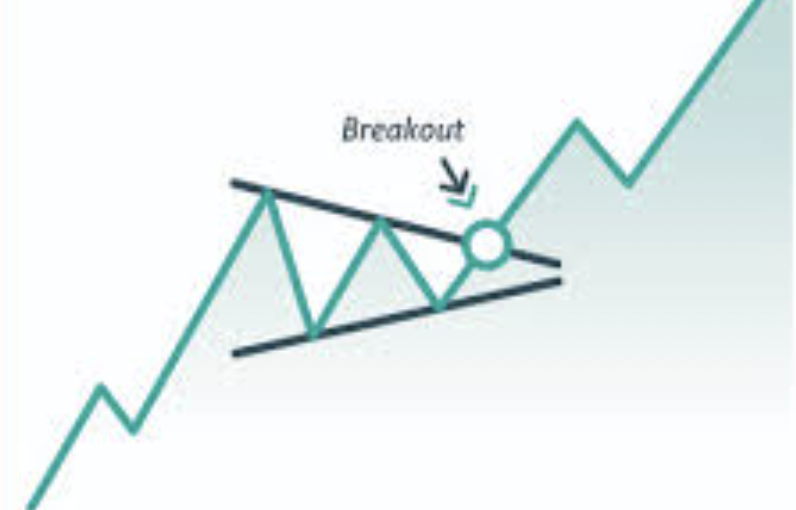
The ascending triangle, sometimes known as the 'rising triangle,' is a popular mid-trend continuation pattern. Traders predict that the market will continue in the direction of the wider trend and therefore build trading setups. 

Learn to Trade the Ascending Triangle Pattern: Main Talking Points

  • An ascending triangle is defined as

  • Recognize an ascending triangle pattern on the FX market charts

  • The ascending triangle trading strategy

  • The ascending triangle's advantages and limitations

  • Utilize our interactive Currency Trading Patterns quiz to assess your understanding of forex patterns. 

What Is An Ascending Triangle?

The ascending triangle pattern is a bullish continuation pattern defined by a rising lower trendline and a flat upper trendline acting as support. As price continues to hit greater lows, this pattern shows that buyers are more aggressive than sellers. When price breaks out of the triangle in the direction of the broader trend, the pattern is complete.


image.png 

The Ascending Triangle as a Bottoming Pattern

The ascending triangle's position in regard to the trend dictates whether a reversal or continuation of the trend is more likely. At the bottom of a downtrend, the ascending triangle may form, indicating that the downward momentum is waning before potentially changing direction. As a result, the position of the pattern is critical.  

How To Identify An Ascending Triangle Pattern On Forex Charts

Once traders understand what to look for, the ascending triangle is pretty straightforward to see on forex charts.


Prior to the emergence of the ascending triangle, the market must be in an uptrend. This is critical and emphasizes the importance of traders not merely trading the ascending triangle pattern everytime it arises.


Consolidation: As the market enters the consolidation period, the rising triangle begins to take shape.


A rising lower trendline may be formed by connecting the lows while the market is consolidating. This ascending trendline indicates that buyers are gradually driving the price upward — providing more evidence for a bullish trading inclination.


Upper trendline is flat: The upper trendline functions as a barrier. Price frequently approaches and bounces off of this level until the breakout happens.


After price breaks decisively above the upper trendline, traders will look for confirmation of the pattern in the form of further upward momentum.


image.png

Ascending Triangle Measuring Technique

The ascending triangle pattern incorporates a built-in measurement mechanism that may be used to estimate possible take profit objectives.


Traders can calculate the distance between the start of the pattern, at the lowest point of the rising trendline, and the flat support line for the ascending triangle. Later on, this identical distance can be transferred, beginning at the breakout point and finishing at the probable take profit level.


The picture below demonstrates how the distance between A and B might be projected further up, from C to D, to project a probable take profit level.


image.png 

How To Trade The Ascending Triangle 

When trading the ascending triangle, traders must first determine the uptrend, as seen in the USD/CAD chart below. Following that, when the forex candlesticks begin to consolidate, the ascending triangle appears. Once the triangle formed, the measuring approach may be utilized as traders await the breakout.


After observing a solid break over resistance, traders may open a long position, putting a stop loss at the previous swing low and establishing a take profit goal consistent with the measurement approach.


image.png 

Advantages And Limitations Of The Ascending Triangle

When examining probable trend continuations, the ascending triangle is a very useful pattern. It does, however, have some drawbacks, which traders should be aware of. 


image.png