• English
  • 简体中文
  • 繁體中文
  • Tiếng Việt
  • ไทย
  • Indonesia
Subscribe
Real-time News
German container shipping company Hapag-Lloyd: Any change of flag still requires further consultation, internal assessment, commercial considerations, and approval of relevant legal and regulatory requirements.The China Earthquake Networks Center officially reported that a magnitude 3.4 earthquake occurred at 18:09 on March 19 in Shaya County, Aksu Prefecture, Xinjiang (41.06 degrees north latitude, 83.56 degrees east longitude), with a focal depth of 17 kilometers.On March 19th, ING economist James Smith stated in a report that weak data from the UK labor market suggests that "the threshold for a Bank of England rate hike is high." The UK unemployment rate remained unchanged at a high of 5.2% in the three months to January. Average wage growth, excluding bonuses, slowed to 3.8% in January from 4.2% in October-December. Smith said, "We still believe that the next step is more likely to be a rate cut, although the timing is increasingly uncertain."March 19th - Industry sources indicate that the pricing coefficient range for new energy vehicle insurance has undergone a new round of adjustments, expanding from [0.6, 1.4] to [0.55, 1.45]. This is the second expansion since September 2025, bringing it very close to the final target of [0.5, 1.5]. "The industry completed the adjustment around March 6th," an industry insider stated. This adjustment will not have a significant impact on new energy vehicle insurance premiums; aside from price fluctuations for a few high-risk vehicles, the premiums for most vehicles will not change substantially.March 19th - Over the past year, the European Central Bank (ECB) has touted its policy as being in "good shape," but the Middle East conflict has disrupted the calm. Markets widely expect the ECB to maintain interest rates at 2% for the sixth consecutive time tonight, but ECB President Christine Lagarde may hint at an imminent rate hike. Claus Vistesen, chief eurozone economist at Pansen Macro, stated, "Policymakers are no longer in good shape, and this meeting will face a difficult communication challenge." Vistesen added that the ECB may raise rates by 25 basis points each in June and July, and the April meeting will also be highly uncertain. Due to its reliance on Middle Eastern energy, Europe is more severely affected by the conflict. Since the outbreak of the war, the benchmark European stock index, the Stoxx 600, has fallen by 4.6%, exceeding the S&P 500s 2.4% decline.

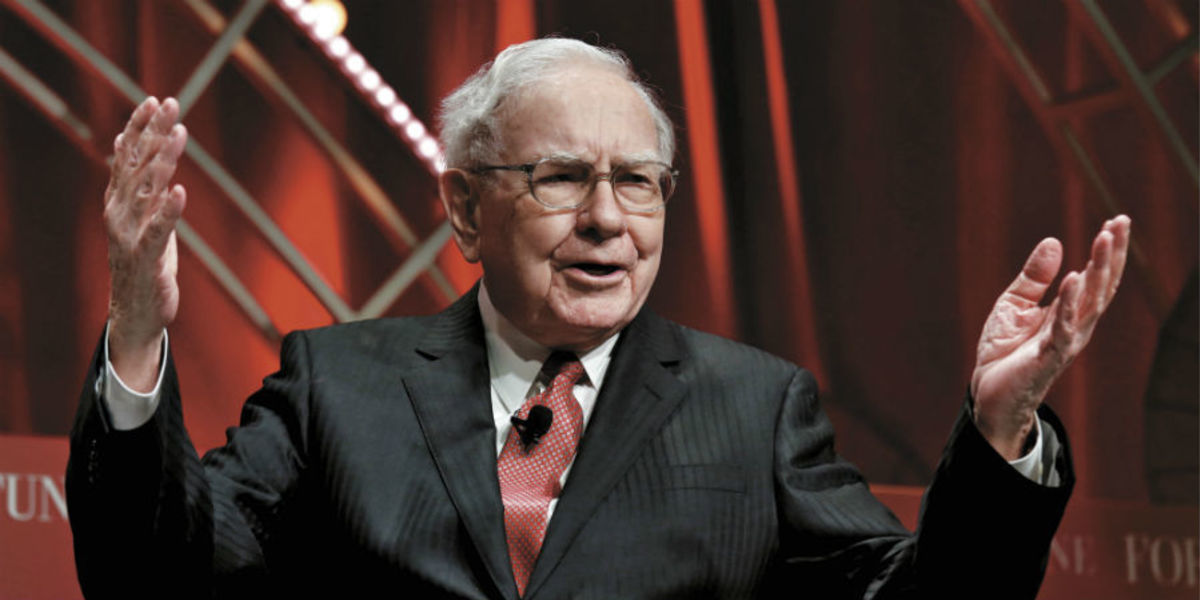
From a farmland to the metropolis, how does American wealth come from? Buffett shares the secrets with you

LEO

Oct 25, 2021 14:05

15353407749945q82ss9r50.jpg


        Before worrying about this data, let's do a simple calculation to understand the importance of GDP per capita. For example, if the US population grows by 3% every year and GDP grows by 2%, then our children's future is indeed bleak. but it is not the truth. We can be sure that the number of births minus the number of deaths will increase the population of the United States by no more than 0.5% per year. The number of immigrants is difficult to predict, but I believe that a reasonable estimate is 1 million per year, which will bring about 0.3% annual population growth.


       All in all, we can expect the US population to grow by about 0.8% annually. Under this assumption, the real GDP of the United States will grow by 2%. After deducting the growth rate of inflation, the per capita GDP will grow by 1.2% every year.


      This growth rate sounds trivial. But over time, it will work miracles. In 25 years, that is, a generation of time, an annual growth rate of 1.2% will increase the current per capita GDP of 59,000 US dollars to 79,000 US dollars. This $20,000 increase will bring a better life to our children. Even so, everyone may think that such a rate of return is nothing special.


Rely on innovation to increase productivity

     I was born in 1930, when the symbol of American wealth was John D. Rockefeller Sr. (John D. Rockefeller Sr.). The middle class today enjoys tourism, entertainment, medical and educational services that Rockefeller and his family cannot enjoy. Even if John D exhausted all his wealth, he would not be able to enjoy the joy and convenience we now take for granted. Two words can explain this miracle: innovation and productivity. On the contrary, if Americans today, as they did in 1776, do the same things in the same way, we will live the same as our ancestors.


      In the early days of the United States, just to provide daily food and cotton, about 80% of workers were required to work on farms. Why are only 2% of workers doing this job now? This is thanks to those who invented tractors, planters, gins, combine harvesters, fertilizers, irrigation systems, and a series of other productivity-enhancing tools.


       Of course, this has an important premise: in the 241 years since the founding of the United States, the progress I described has destroyed and replaced almost all of our labor force at that time. If this drastic change is foreseen early, the strong opposition of workers will certainly make these innovations hard to escape the fate of failure. Some people may ask, can these unemployed farmers find jobs?


       Today we know that the tremendous progress in agricultural productivity is a good thing. It frees up nearly 80% of the country’s workforce and invests them in new industries that change our way of life. You can describe these developments as increasing or destroying productivity. No matter which label is used, they all explain why we now have a staggering GDP per capita of $59,000.


       This economic miracle is still in its early stages. In the future, Americans will benefit from more and better "things." The challenge we face will be how to let those whose lives are affected by social progress lead a better life. On this issue, many people’s concerns are justified.


Disadvantages of market economy

       In 1930, some experts predicted that in my lifetime, per capita GDP would increase 6 times. My parents did not hesitate to think this was impossible. Decades later, "Forbes 400" told us a completely different picture. Since the first statistics in 1982, the wealth of the top 400 people has increased 29-fold, from 93 billion US dollars to 2.7 trillion US dollars, while millions of hardworking citizens are still stuck on the economic bicycle. During this period, the tsunami of wealth did not benefit the lower class, but moved upward.


       In 1776, the United States had a market economy, the rule of law, and equal opportunities at the same time, which unleashed human potential. This is a genius system. It took only 241 years to turn the original villages and grasslands into a fortune of 96 trillion US dollars. But at the same time, the market system has left many people hopelessly behind, especially as this market becomes more and more specialized. These side effects can be improved: a wealthy family takes care of all children, not just those with market value.


       In the future growth, I have no doubt that the United States can not only bring wealth to many people, but also enable everyone to live a decent life. We cannot just be satisfied with this.


(Translated from Warren Buffett Shares the Secrets to Wealth in America, Time Magazine, January 2018)