• English
  • 简体中文
  • 繁體中文
  • Tiếng Việt
  • ไทย
  • Indonesia
Subscribe
Real-time News
On September 4th, according to Qichacha APP, Wuhan Xinrongguang Technology Co., Ltd. was recently established, with Sun Peng as the legal representative and a registered capital of 13.2 billion yuan. Its business scope includes integrated circuit design; integrated circuit chip design and services; integrated circuit chip and product manufacturing; and power electronic component manufacturing. Qichachas equity penetration analysis shows that the company is jointly held by Wuhan Xinxin Integrated Circuit Co., Ltd. (a subsidiary of Yangtze Memory Technologies Co., Ltd.), Wuhan Optics Valley Semiconductor Industry Investment Co., Ltd., and China Internet Investment Fund (Limited Partnership), among others.September 4th - As a major global player in the power battery industry, my country has recently been actively promoting the development of international standards in key areas such as power battery thermal management and the recycling of retired batteries within the framework of international organizations like the International Organization for Standardization (ISO) and the International Electrotechnical Commission (IEC), based on its industrial practices. This aims to provide standardization support for the coordinated development of the global power battery industry. Going forward, the State Administration for Market Regulation will guide more professionals in the production, use, and recycling of power batteries to participate in international standards research, deepen practical exchanges on standardization with other countries, and contribute to the high-quality and sustainable development of the new energy industry throughout its entire lifecycle.Tesla (TSLA.O) Robotaxi announced that its Cybercab driverless ride-hailing service will be open to the public for test rides starting at 5 p.m. Central Time on Friday (6 a.m. Beijing Time the following day).On September 4th, Tesla (TSLA.O) announced that it has begun offering ride-hailing services for its two-seater Cybercab in a "limited area" in Austin, Texas. This vehicle lacks a steering wheel and pedals. In response, U.S. automotive safety regulators stated that they are evaluating the situation. Tesla CEO Elon Musk has stated that the Cybercab will be a key product enabling Tesla to become a dominant force in the field of self-driving cars. Meanwhile, the National Highway Traffic Safety Administration (NHTSA) is responsible for developing and enforcing vehicle safety regulations, including overseeing the safety of new vehicle models. An NHTSA spokesperson stated, "The NHTSA is in communication with Tesla and is evaluating the situation." However, the spokesperson did not provide further details.On September 4th, Huawei Consumer Business Group announced the release of the Huawei WATCH 6 Pro, the first all-ceramic smartwatch in the WATCH series. The device is expected to be equipped with HarmonyOS 7 and bring new health-related features.

Fibonacci Theory

Larissa Barlow

Mar 23, 2022 17:14

History of Fibonacci 

Before we get too far into the meaning of Fibonacci, let us first address the question, "Who is Fibonacci?" Leonardo Pisano, or Leonardo Fibonacci, was a Middle Ages European mathematician who published the Liber Abaci (Book of Calculation) in 1202 AD. He covered a range of themes in this book, including how to convert currencies and measures for business, how to calculate profit and interest, and how to solve a variety of mathematical and geometric equations. However, there are two points that immediately come to mind in today's environment. To begin, he highlighted the advantages of employing the Arabic numeral system in the opening sections of Liber Abaci. At the period, the defunct Roman Empire retained a great impact, and the majority of European inhabitants preferred to use Roman numerals. However, in Liber Abaci, Fibonacci made a compelling, persuasive, and simple-to-understand case for the use of the Arabic number system. From that point on, the Arabic numeral system established a firm footing in the European community and quickly became the region's and subsequently the world's dominant technique of mathematics. It was so successful that we continue to use the Arabic number system today.


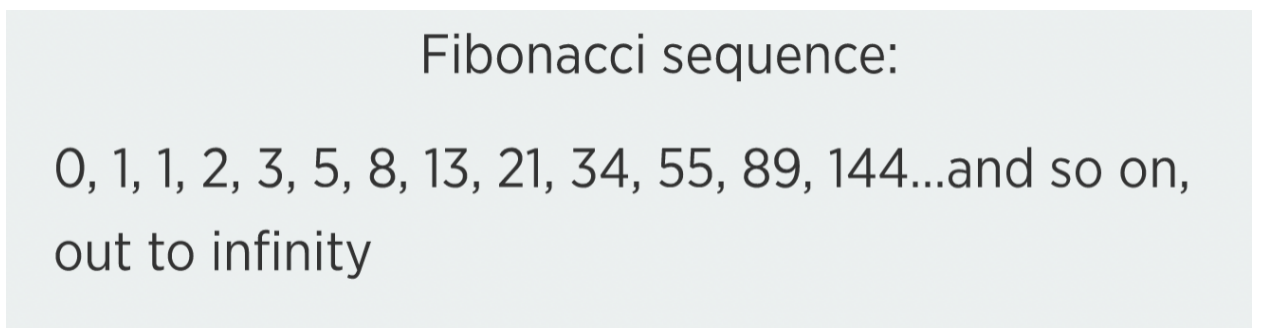
The Fibonacci sequence is the second significant piece of Liber Abaci that we utilize today. The Fibonacci sequence is a set of numbers in which each number equals the sum of the two preceding numbers.


image.png 


As indicated by this sequence, we must begin with two "seed" integers, namely 0 and 1. After that, we add 0 and 1 to obtain the next digit in the series, which is 1. Then, you add that value to the previous one to obtain the next number in the sequence. If we continue along that path, we arrive at the following:


image.png 


The Fibonacci sequence is critical to our subject because it provides us with the numbers necessary to calculate our Fibonacci ratios. The Fibonacci ratios would not exist without the Fibonacci sequence.

What Is a Fibonacci Ratio?

With the advent of the internet, there has been a great deal of confusion over the values that comprise Fibonacci Ratios. The widespread use of Fibonacci analysis, particularly in the domain of trading, has bred misconceptions and misunderstandings about how and what constitutes a Fibonacci ratio. Consider what a Fibonacci ratio is, how it is calculated, and some instances of non-Fibonacci ratios.

Fibonacci Ratios

The mathematics underlying the Fibonacci ratios is rather straightforward. All we have to do is choose a few numbers from the Fibonacci sequence and divide them evenly. Consider the following example: Take a number in the sequence and divide it by the number immediately following it.


0 ÷ 1 = 0

1 ÷ 1 = 1

1 ÷ 2 = 0.5

2 ÷ 3 = 0.67

3 ÷ 5 = 0.6

5 ÷ 8 = 0.625

8 ÷ 13 = 0.615

13 ÷ 21 = 0.619

21 ÷ 34 = 0.618

34 ÷ 55 = 0.618

55 ÷ 89 = 0.618


Have you seen a trend emerging here? From 21 to 34 divided by 34, you will ALWAYS get 0.618!


We could perform the same thing with any other number in the Fibonacci sequence. For instance, by dividing a number in the series by the preceding number, another constant number forms.


1 ÷ 0 = 0

1 ÷ 1 = 1

2 ÷ 1 = 2

3 ÷ 2 = 1.5

5 ÷ 3 = 1.67

8 ÷ 5 = 1.6

13 ÷ 8 = 1.625

21 ÷ 13 = 1.615

34 ÷ 21 = 1.619

55 ÷ 34 = 1.618

89 ÷ 55 = 1.618

144 ÷ 89 = 1.618


Another pattern emerges from the Fibonacci numbers. Now, 1.618 is much more significant since it is also known as the Golden Ratio, the Golden Number, or the Divine Ratio, although I could go on and on about that subject for many more pages.


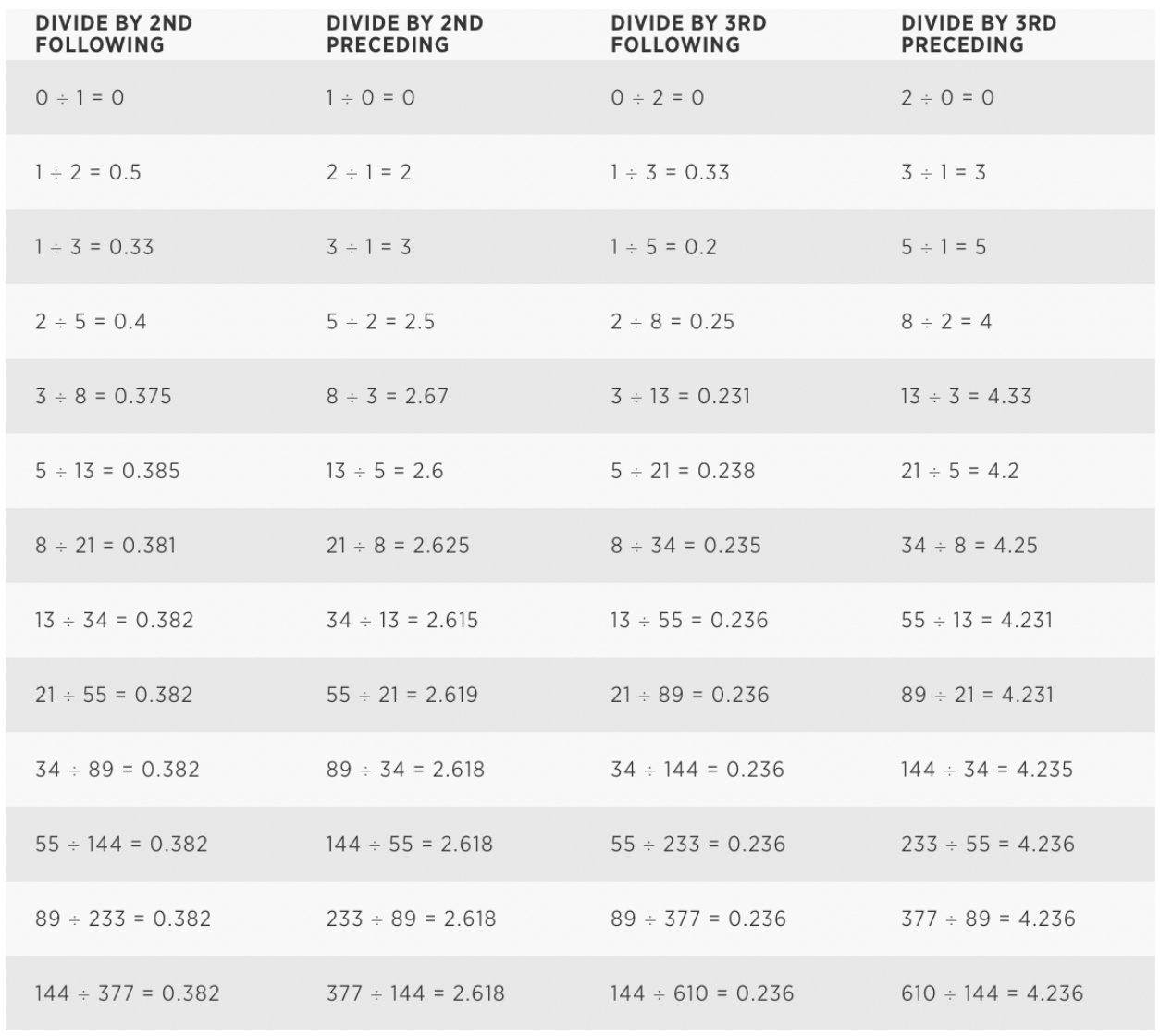
Here are some further instances of patterns that emerge by splitting the Fibonacci sequence's numbers in a pattern with other sequence numbers.


image.png 


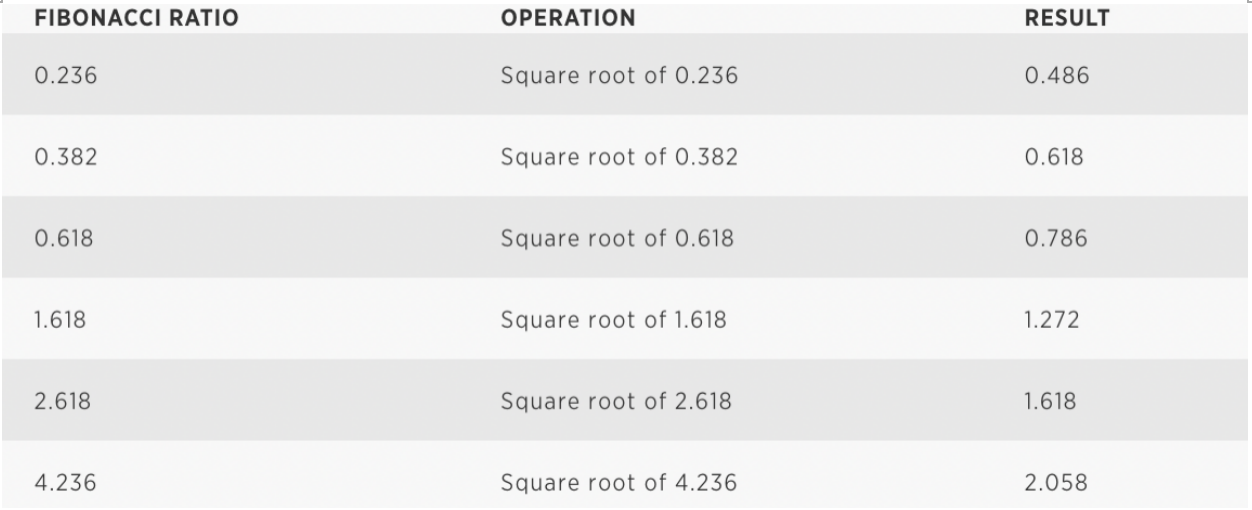
As you can see, we may obtain a large number of distinct numbers just by choosing integers from the Fibonacci sequence and building a divisory pattern inside it. This is not, however, the sole method for calculating Fibonacci ratios. Once we get the division results, we may take the square roots of each of those numbers to obtain further numbers. The graphic below illustrates some of those values.


image.png 


The final step in converting these values to Fibonacci ratios is to convert them to percentages. 0.236 becomes 23.6 percent, 0.382 becomes 38.2 percent, and so on. Therefore, based on our investigation, 23.6 percent, 38.2 percent, 48.6 percent, 61.8 percent, 78.6 percent, 127.2 percent, 161.8 percent, 205.8 percent, 261.8 percent, and 423.6 percent are our genuine Fibonacci ratios.

What about 50%?

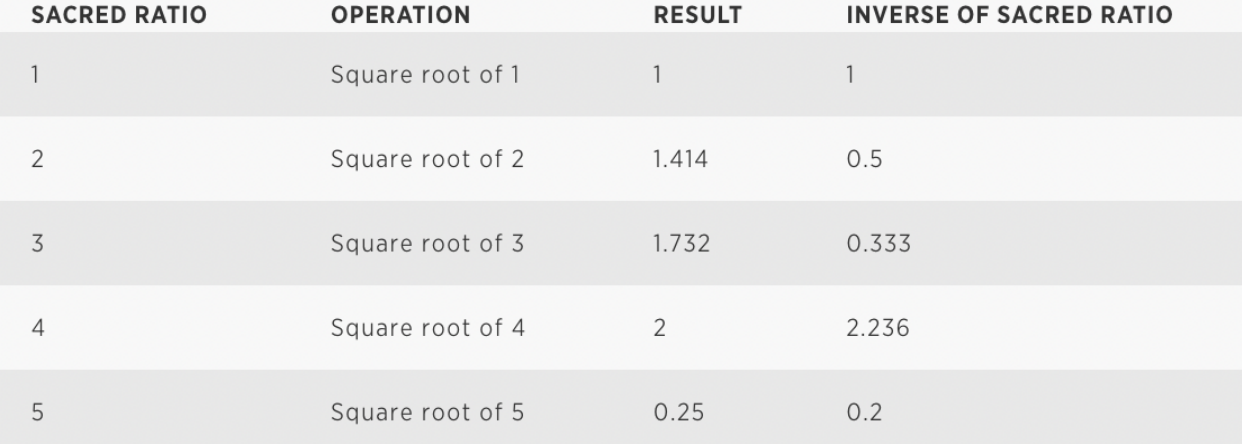
While it is frequently employed in Fibonacci analysis, the 50% ratio is not a Fibonacci ratio. According to some, the 50% level is a Gann ratio developed in the early 1900's by W.D. Gann. Others refer to the 50% level as the opposite of a "holy ratio." Similar to the Fibonacci ratios, many people use the inverse or square root of the "holy ratios" to generate additional values. The table below has several instances.


image.png 


Whichever source is used, the 50% ratio appears to be a very significant and meaningful level while trading, and hence is frequently included in Fibonacci analysis as if it were a Fibonacci ratio. Several additional values in the table have been misidentified as Fibonacci ratios, but are clearly not.


Whichever source is used, the 50% ratio appears to be a very significant and meaningful level while trading, and hence is frequently included in Fibonacci analysis as if it were a Fibonacci ratio. Several additional values in the table have been misidentified as Fibonacci ratios, but are clearly not.